The Ultimate Guide to SEO: From Search Basics to Technical Mastery
Table of Contents
- What is SEO and Why is it Important?
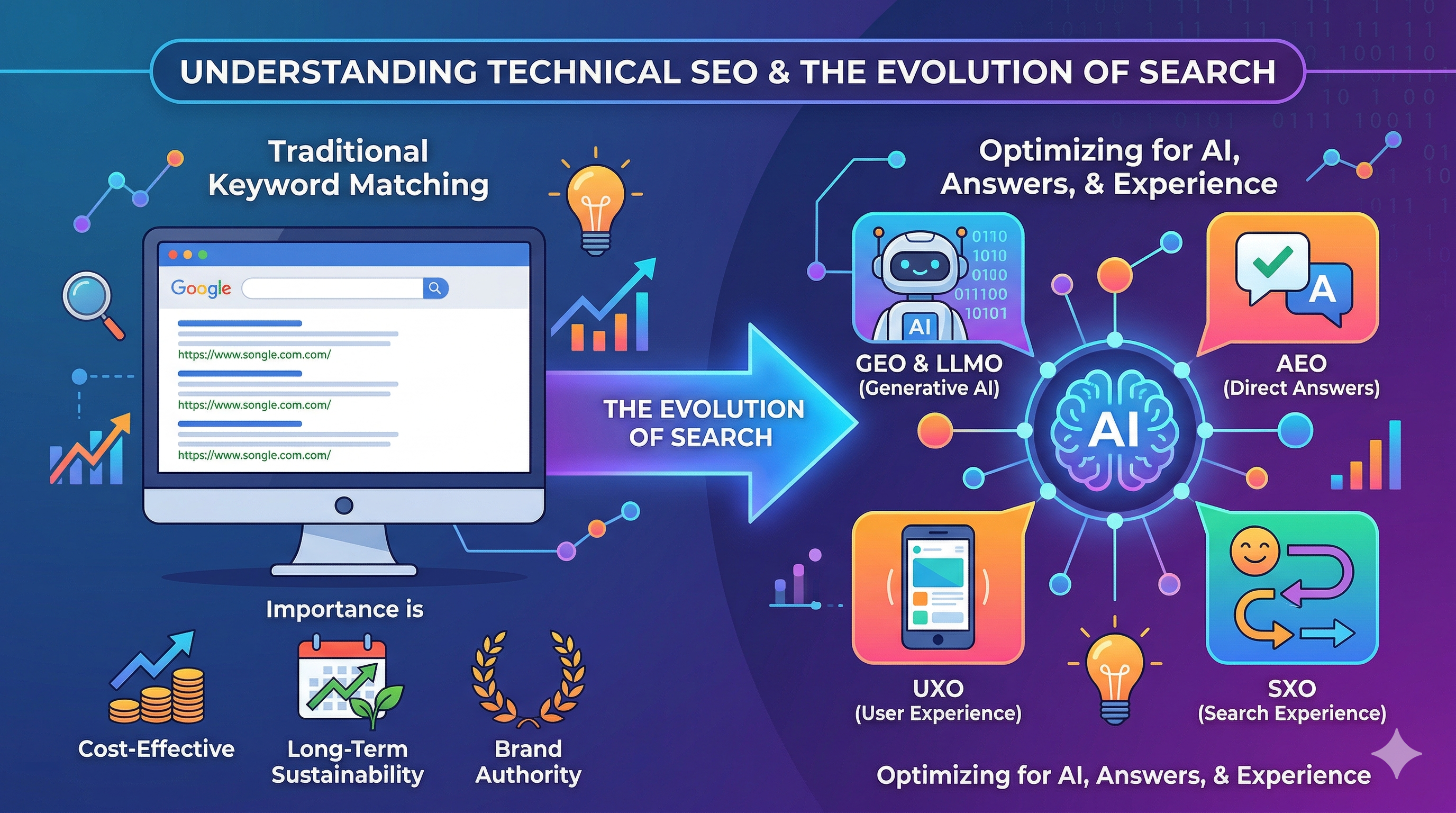
- The Evolution of Search: GEO, AEO, LLMO, UXO, & SXO
- Demystifying Web Crawlers
- The Three Pillars of SEO
- Pillar 1: On-Page SEO (Keywords & Content)
- Pillar 2: Off-Page SEO (Authority & Backlinks)
- Pillar 3: Technical SEO (Performance & Structure)
1. What is SEO and Why is it Important?
SEO (Search Engine Optimization) is the strategic process of refining a website to improve its online visibility within a Search Engine Results Page (SERP). The ultimate goal is to rank your web pages as close to the top position on the first page as possible for relevant user queries.
Why is SEO so critical for business?
- Cost-Effective Traffic: Unlike paid advertising (PPC), organic SEO does not require a budget spend for every click.
- Long-Term Sustainability: Once you achieve a high ranking through solid optimization, your site can generate consistent traffic for months or even years.
- Brand Authority & Awareness: Users inherently trust search engines. Ranking at the top of the SERP establishes your brand as an authoritative leader in your industry.
<a id="evolution-of-search"></a>
2. The Evolution of Search: GEO, AEO, LLMO, UXO, & SXO
The search landscape is rapidly evolving beyond traditional keyword matching. Today, optimizing for search means optimizing for AI, answers, and user experience.
- GEO (Generative Engine Optimization): Optimizing content so that AI-driven search engines (like Google's AI Overviews) pull your website's data to generate their summaries.
- AEO (Answer Engine Optimization): Structuring content specifically to provide direct, concise answers to user queries, increasing the chances of appearing in Voice Search results or "People Also Ask" snippets.
- LLMO (Large Language Model Optimization): The practice of ensuring your brand, products, and facts are properly understood and referenced by foundational AI models like ChatGPT or Claude.
- UXO (User Experience Optimization): Focusing on the usability, accessibility, and visual appeal of your website. Search engines prioritize sites that users find easy to navigate.
- SXO (Search Experience Optimization): A hybrid of SEO and UXO. It focuses on the entire journey: from the moment a user searches a query, clicks your link, navigates your site, and successfully finds their answer or makes a purchase.
<a id="web-crawlers"></a>
3. Demystifying Web Crawlers
Before a page can rank, a search engine must know it exists. This is done through Crawlers (also known as web spiders or bots).
What is a Crawler? A crawler is an automated software program that browses the internet, discovers websites, reads their content, and follows links to find new pages.
Popular Examples of Crawlers:
- Googlebot: Google's primary crawler.
- Bingbot: Microsoft Bing's crawler.
- DuckDuckBot: DuckDuckGo's crawler.
- Baiduspider: The crawler for Baidu (China's leading search engine).
- Yandex Bot: The crawler for Yandex (Russia's leading search engine).
How Crawlers Work:
- Crawling (Discovery): The bot arrives at your site, reads the text, looks at the images, and follows internal and external links to understand the site's structure and topics.
- Indexing (Filing): Once the content is understood, the bot categorizes it and stores it in a massive database (the Index).
- Retrieval (Ranking): When a user types a query, the search engine searches its index and retrieves the most relevant, high-quality results, ordering them in the SERP.
4. The Three Pillars of SEO
A successful SEO strategy requires a balanced approach across three main disciplines:
- On-Page SEO: Optimizing the content and HTML of the actual webpage.
- Off-Page SEO: Building external authority and trust for your website.
- Technical SEO: Enhancing the backend architecture and performance of your site.
5. Pillar 1: On-Page SEO
On-page SEO ensures your content directly answers the user's query while making it easy for crawlers to understand.
Keyword Research
Keywords are the terms your target audience types into search engines. Finding the right ones requires analyzing two main metrics:
- Search Volume: The average number of times a keyword is searched per month.
- Keyword Difficulty (KD): A metric (usually 0-100) indicating how hard it is to rank for that term against competitors.
Types of Keywords (By Length):
- Short-Tail: Broad terms (1-2 words). E.g., Running shoes.
- Mid-Tail: More specific (3 words). E.g., Trail running shoes.
- Long-Tail: Highly specific phrases (4+ words). E.g., Best trail running shoes for flat feet.
Types of Keywords (By Intent):
- Informational (I): User wants to learn. (How to train for a marathon?)
- Navigational (N): User is looking for a specific site. (Nike login)
- Commercial (C): User is comparing options before buying. (Nike vs. Adidas running shoes)
- Transactional (T): User is ready to buy. (Buy Nike Pegasus 40 online)
Core On-Page Elements
- Meta Title: The clickable blue headline in the SERP. It must contain the primary keyword and be under 60 characters.
- Meta Description: The summary text below the title in the SERP. It should be engaging, include the keyword, and stay under 160 characters.
- Slug: The exact URL path of the page (e.g., yourwebsite.com/seo-guide). It should be clean and contain the keyword.
- Headings (H1-H6): Used to structure content. You should only have one H1 tag (the main title). H2s and H3s organize subtopics and should include secondary keywords.
- Keyword Density: The percentage of times your keyword appears compared to the total word count. Aim for 1% to 2%. Exceeding this can lead to penalties for "keyword stuffing."
6. Pillar 2: Off-Page SEO
Off-page SEO is all about building your website's Authority. Authority is essentially a measure of how much search engines trust your website based on external signals.
Understanding Links
- Internal Link: A link pointing from one page on your site to another page on your site.
- External (Outbound) Link: A link pointing from your site to a different website.
- Inbound Link (Backlink): A link from a different website pointing to your site. Backlinks act as "votes of confidence" in the eyes of search engines.
Key Authority Metrics
- DA (Domain Authority): The overall ranking power of your entire website (scored 0-100).
- PA (Page Authority): The ranking power of a specific page on your site.
- Spam Score: A metric that measures the percentage of toxic or spammy links pointing to your site. Keep this as low as possible.
Link Directives
- Do-Follow: Tells crawlers to follow the link and pass authority (ranking power) to the receiving site.
- No-Follow: Tells crawlers not to pass authority. Useful for sponsored links or user-generated comments.
- Index / No-Index: A tag telling search engines whether they should include a specific page in their search results at all.
How to Create Backlinks
- Guest Blogging: Writing articles for other authoritative sites in your industry in exchange for a link back to yours.
- PR (Press Releases): Getting featured in digital news publications.
- Directory & Business Listings: Creating profiles on Google My Business, Yelp, or industry-specific directories.
- Social Signals & Forums: Sharing content on social media, Reddit, or Quora to generate referral traffic.
- Email Outreach: Reaching out to webmasters and asking them to link to your high-quality content.
7. Pillar 3: Technical SEO
Technical SEO ensures your website is fast, secure, and easy for bots to crawl.
Speed and Core Web Vitals
Website performance directly impacts both user experience and rankings. Key metrics include:
- LCP (Largest Contentful Paint): Measures how long it takes for the largest piece of content (image or text block) on the screen to load.
- FCP (First Contentful Paint): Measures the time until the very first piece of content appears on the screen.
- Speed Index: How quickly the contents of a page are visibly populated.
- TBT (Total Blocking Time): Measures how long the page is blocked from responding to user inputs (like clicks or taps) while loading.
Code & Architecture
- Schema Markup (JSON-LD): A piece of code added to the backend of your site that translates your content into a format search engines easily understand. It is essential for getting Rich Snippets (like star ratings, recipe times, or FAQs) in the SERP.
- OG Tags (Open Graph): HTML tags that control how your webpage looks when shared on social media (ensuring the correct image, title, and description appear).
- Canonical Tag: A tag (rel="canonical") that tells search engines which version of a URL is the "master" copy. This prevents penalties if you have duplicate content on your site.
- Sitemap: * XML Sitemap: A file listing all important URLs on your site, designed specifically to help search engine crawlers find your pages.
- HTML Sitemap: A visual directory designed to help human users navigate your site.
- Robots.txt: A text file placed in your site's root directory that gives strict instructions to web crawlers about which pages they are allowed (or not allowed) to crawl.
- .htaccess File: A server configuration file used to manage URL redirects (like permanent 301 redirects), enhance security, and manage cache control.