Programmatic SEO: The Ultimate Guide to Scalable Organic Growth
Search engine optimization has traditionally been a slow, manual process writing one page at a time, targeting one keyword at a time. But as the digital landscape becomes more competitive, businesses need faster, more scalable ways to capture search demand. This is where programmatic SEO comes in.
Programmatic SEO is not just a tactic; it’s a growth system. When done right, it allows you to create hundreds or even thousands of high-quality, search-optimized pages using data, templates, and automation without compromising on value.
In this guide, you’ll understand what programmatic SEO is, why it matters, which businesses should use it, and how to implement it step by step using both WordPress and modern frameworks like Next.js.
What is Programmatic SEO?
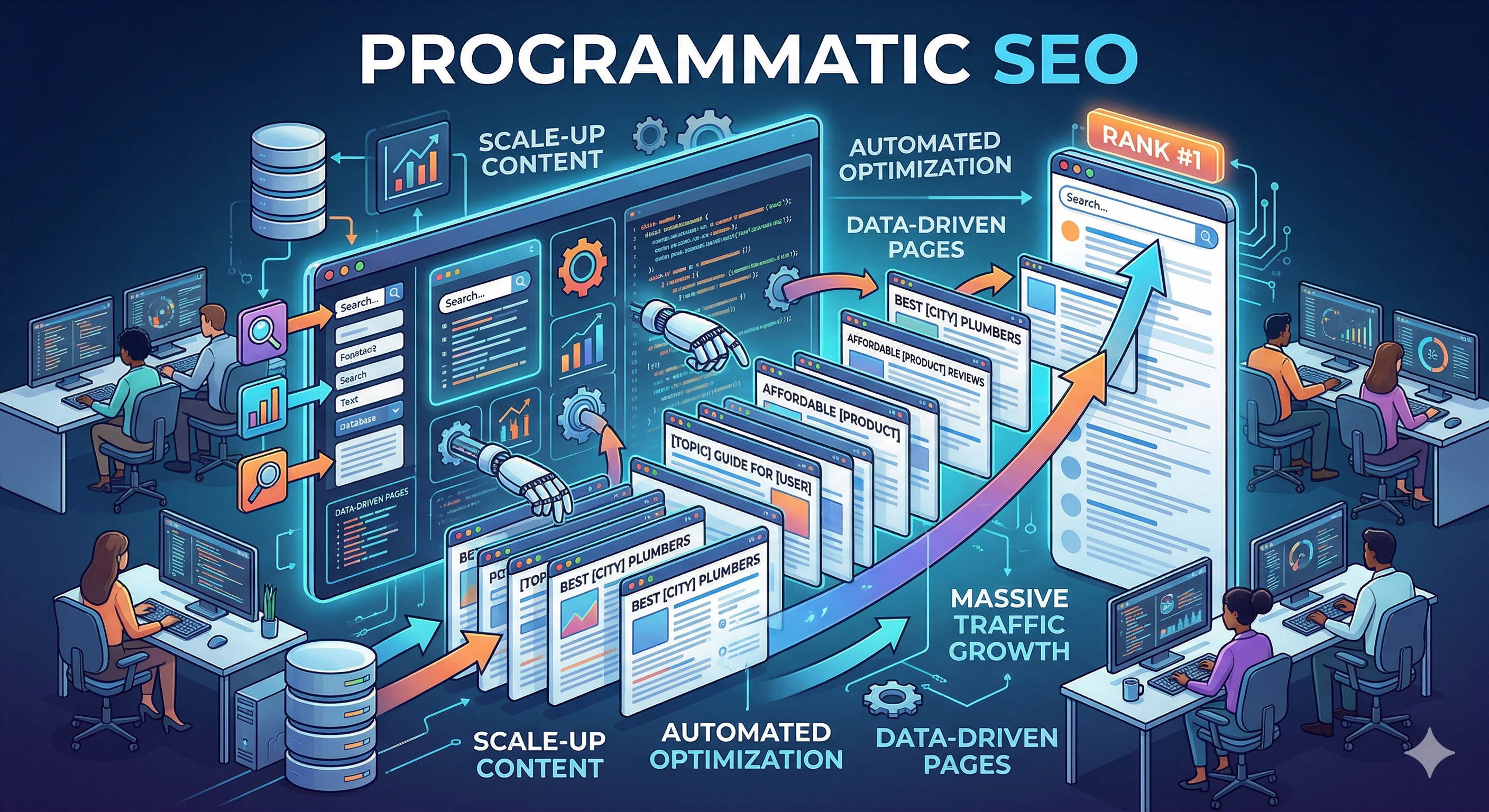
Programmatic SEO is a method of generating large numbers of web pages by combining structured data with predefined templates. Instead of manually writing each page, you build a system that dynamically creates pages based on keyword patterns.
For example, instead of writing separate articles like:
- “Best SEO agencies in Bangalore”
- “Best SEO agencies in Mumbai”
- “Best SEO agencies in Delhi”
You create a single template and a dataset of cities. The system then generates all these pages automatically.
At its core, programmatic SEO relies on three components:
- Keyword patterns
- Structured datasets
- Scalable page templates
When these elements are combined effectively, you can target thousands of long-tail search queries with minimal manual effort.
Benefits of Programmatic SEO
One of the biggest advantages of programmatic SEO is scalability. Traditional SEO limits you to how much content you can manually produce, but programmatic SEO removes that bottleneck.
First, it allows you to capture long-tail traffic at scale. Individually, these keywords may have low search volume, but collectively they can drive massive traffic.
Second, it significantly reduces content production time. Instead of spending weeks writing content, you can generate hundreds of pages in a few hours once your system is in place.
Another key benefit is cost efficiency. After the initial setup, the marginal cost of creating new pages is almost zero. This makes it extremely attractive for startups and growing platforms.
Programmatic SEO also attracts high-intent users. Since pages are highly specific, users landing on them are often closer to taking action whether it’s signing up, purchasing, or engaging.
Finally, it enables data-driven optimization. Because all pages follow a structured format, you can test and improve templates at scale, leading to continuous performance gains.
Which Businesses Should Use Programmatic SEO?
Programmatic SEO works best for businesses that have structured, repeatable data. If your business model allows you to create variations of similar content, this approach can be extremely powerful.
Marketplaces are a perfect fit. Job portals, real estate platforms, and freelance marketplaces can generate pages like “Jobs for designers in Bangalore” or “Apartments for rent in Mumbai.”
SaaS companies also benefit significantly. Tools like SEO analyzers, calculators, or AI platforms can create pages targeting specific use cases, such as “keyword density tool for bloggers.”
E-commerce websites can leverage programmatic SEO for category pages, filtered listings, and product comparisons.
Directory websites such as agency listings or local service directories are another strong use case, as they naturally rely on structured data.
Content platforms, especially those focused on glossaries, templates, or tutorials, can also scale effectively using this strategy.
However, programmatic SEO is not suitable for every business. If your content requires deep expertise, originality, or storytelling, relying purely on automation can lead to low-quality pages and poor rankings.
Step-by-Step Process to Build Programmatic SEO
The first step is identifying keyword patterns. Instead of focusing on individual keywords, look for repeatable structures like “best {service} in {city}” or “{tool} for {audience}.” These patterns form the foundation of your strategy.
Next, you need to build a dataset. This could be a list of cities, products, services, or any structured information relevant to your niche. The more comprehensive your dataset, the more pages you can generate.
Once your data is ready, you create a page template. This template should include all essential SEO elementssuch as headings, descriptions, FAQs, and internal linkswhile leaving placeholders for dynamic content.
After that, you generate pages programmatically by combining your dataset with the template. Each combination produces a unique URL and page.
Optimization is the next critical step. Every page should have a unique title, meta description, and relevant on-page SEO elements. Adding schema markup can further enhance visibility in search results.
Finally, you need to monitor performance. Use tools like Google Search Console to track indexing, impressions, and rankings. Based on the data, continuously refine your templates and content.
How to Implement Programmatic SEO in WordPress
WordPress offers a relatively simple way to implement programmatic SEO, especially for non-developers.
You can start by creating a custom post type for example, “City Pages” or “Service Pages.” Then, use plugins like Advanced Custom Fields (ACF) to define dynamic fields such as city name, service type, and descriptions.
Once your structure is ready, you can import data using a CSV file. Each row in the file becomes a new page, populated with dynamic content.
To design the page layout, you can use tools like Elementor or Gutenberg. These allow you to insert dynamic fields into templates without writing code.
For SEO optimization, plugins like Rank Math or Yoast SEO help you generate dynamic meta titles and descriptions.
While WordPress is easy to set up, it has limitations in terms of performance and scalability, especially when dealing with very large datasets.
How to Implement Programmatic SEO in Next.js
For businesses aiming to scale aggressively, a custom-coded solution using Next.js is more powerful.
Next.js allows you to create dynamic routes and generate pages statically, ensuring fast load times and excellent SEO performance.
You start by storing your dataset in a JSON file, database, or API. Then, create dynamic routes that map to your keyword patterns.
Using functions like getStaticPaths, you define all possible page variations. With getStaticProps, you fetch the required data for each page.
The template component renders the page using dynamic variables such as city and service. You can also add metadata dynamically to optimize each page for search engines.
One of the biggest advantages of Next.js is Incremental Static Regeneration (ISR), which allows you to update pages without rebuilding the entire site.
This approach offers unmatched scalability and performance but requires technical expertise to implement correctly.
Common Mistakes to Avoid
One of the biggest mistakes in programmatic SEO is creating thin or duplicate content. Simply swapping keywords without adding value can harm your rankings.
Another common issue is poor internal linking. Without a strong linking structure, search engines may struggle to discover and index your pages.
Ignoring user experience is also risky. Even if your pages rank well, poor design or irrelevant content can lead to high bounce rates.
Finally, many businesses fail to differentiate their content. To succeed, you must go beyond templates and include unique insights, data, or user-generated content.
Final Thoughts
Programmatic SEO is one of the most effective ways to scale organic traffic in today’s competitive digital environment. It transforms SEO from a manual effort into a systematic, data-driven process.
However, success depends on execution. The combination of structured data, well-designed templates, and high-quality content is what separates high-performing programmatic SEO strategies from those that fail.
If you approach it strategically, programmatic SEO can become a long-term growth engine driving consistent traffic, improving conversions, and giving you a significant edge over competitors.