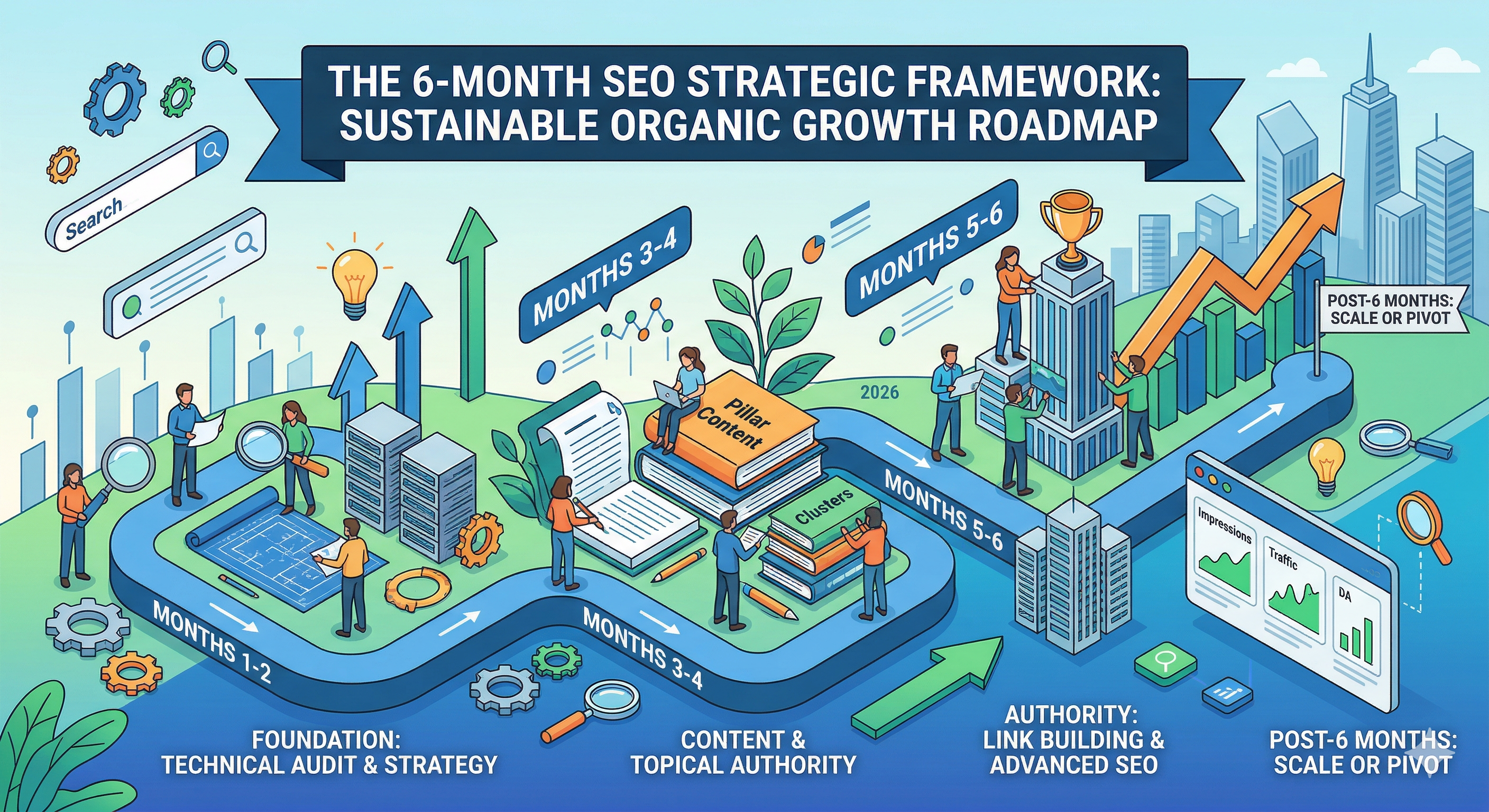
The 6-Month SEO Strategic Framework: A Roadmap to Sustainable Organic Growth
SEO is less of a "set it and forget it" task and more of a long-term compound interest investment. To win across any industry be it e-commerce, SaaS, or local services you need a structured approach that moves from fixing the "engine" to fueling the "content."
Part 1: The 6-Month Strategic Framework
Months 1-2: The Technical & Strategic Foundation
Before you build the house, you must ensure the foundation is level. If Google can’t crawl you, you can’t rank.
- Full Technical Audit: Identify 404 errors, crawl loops, and "no-index" tags that shouldn't be there.
- Keyword Mapping: Don't just find keywords; assign them. Every URL should have a Primary Keyword and 3–5 Semantic (LSI) Keywords.
- Core Web Vitals (CWV): Aim for "Green" status in LCP and FCP.
- Fixing Metadata: Rewrite all Meta Titles and Descriptions to ensure the primary keyword is at the beginning.
Months 3-4: Content Architecture & Topical Authority
Search engines now prioritize "Topical Authority" over individual keyword ranking. You need to prove you are an expert in your niche.
- Pillar & Cluster Content: Create 2–3 "Pillar" pages (deep-dive guides) and 10–12 "Cluster" posts (specific sub-topics) that link back to them.
- Internal Linking: Ensure your "link equity" flows from high-authority blog posts to your "money pages" (service or product pages).
- UXO (User Experience Optimization): Improve site navigation and mobile responsiveness.
Months 5-6: Authority Building & Modern Optimization (AEO/GEO)
Now that your site is fast and your content is great, you need external "votes of confidence."
- Backlink Acquisition: Focus on Quality over Quantity. Secure 3–5 high-DA guest posts or niche edits rather than 100 directory links.
- AEO/GEO Tweaks: Format your content into FAQ sections using JSON-LD Schema to capture AI-generated answers and voice search.
- CRO (Conversion Rate Optimization): Start analyzing why users aren't converting. Is the CTA (Call to Action) clear?
Part 2: Key Metrics (KPIs) to Observe
SEO metrics are "leading" and "lagging." You won't see sales (lagging) until you see impressions (leading).
Period
Primary Metric
What it Tells You
Month 1-2
Indexing & Impressions
Is Google actually "seeing" and "reading" the changes?
Month 3-4
Avg. Position & Organic Traffic
Are your pages moving from Page 5 to Page 2?
Month 5-6
Conversion Rate & Dwell Time
Are users staying on the site and taking action?
Ongoing
Domain Authority (DA)
Is your brand's overall "trust" increasing in the eyes of Moz/Ahrefs?
Part 3: The Post-6-Month Plan
Scenario A: If Everything Goes Well (Targets Reached)
If you’ve hit your traffic and conversion goals, do not stop. SEO is competitive; if you stop, a competitor will take your spot.
- Double Down on Winners: Identify the top 20% of pages driving 80% of your traffic. Update them with new data and images to keep them "fresh."
- Expand into New Clusters: Take the success of your first "Pillar" and replicate it for a secondary service or product line.
- Experiment with GEO: Since you have authority, start optimizing specifically for Generative AI summaries (AI Overviews).
- Scale Link Building: Increase your PR outreach to secure even higher-tier media mentions.
Scenario B: If Targets Are Not Reached (The Pivot)
SEO can be delayed by "The Sandbox" (Google’s waiting period for new sites) or algorithm updates. If you aren't seeing results:
- Re-Audit Content Quality: Check your Helpful Content score. Is your content actually better than the top 3 results, or is it just "more of the same"?
- Check for Cannibalization: Are two of your pages fighting for the same keyword? If so, merge them into one powerhouse page.
- Analyze Competitor Shifts: Did a new competitor enter the market with a massive backlink budget? Adjust your strategy to target Long-Tail Keywords with lower difficulty.
- Verify Search Intent: You might be ranking for "Informational" keywords when the user actually wants "Transactional" results. Align your page type with the user's goal.